
Walk a Kihei Street Directory
A sound street-by-street search starts with the place, not a guessed person. Maui County records can identify a parcel, its assessed owner, the county mailing fields, and permit history. State land records can then show parties to recorded instruments. Historical directories may add a dated household or business link. None is a complete list of current occupants. Use this sequence to keep each record in its proper role:
- Normalize the full address through USPS, then preserve that postal version exactly.
- Search Maui County by address. Record the TMK, which is the tax map key used across parcel systems.
- Open the state parcel layer and confirm the polygon, section, plat, parcel, and source date.
- Check MAPPS and the county public-documents index for permits, plans, inspections, code cases, and older folders.
- Use the TMK, names, and dates in the Bureau of Conveyances index. Treat each person as a party to an instrument, not an occupant.
- For a dated household clue, ask the library or archives about island directories and any reverse-address section for the target year.
The result should read as a chain of evidence: postal address to county situs, situs to TMK, TMK to map and permit files, then TMK or party name to a deed. If a goal shifts to one named person, the Kihei resident lookup uses a different verification path.
Kihei Street Parcel Search
The Maui public parcel search accepts more than a street line. It links modern addresses to the record keys that survive spelling changes and format differences. Start exact, then remove punctuation or switch to the TMK when a unit, suffix, or old label causes no result. The wildcard * is accepted in the broader public-documents index.
| Search field | Format or use | What to retain |
|---|---|---|
| Address | Street address and city | County wording and matched parcel |
| Owner name | Current assessment name | Name, owner type, source date |
| TMK | Enter without dashes, such as the documented 13-digit pattern | Full parcel key |
| Permit type | Category filter | Record category and number |
| Permit number | YYYYNNNN | Permit year and record identifier |
The official Maui parcel and permit search shows the actual address-keyed starting screen.
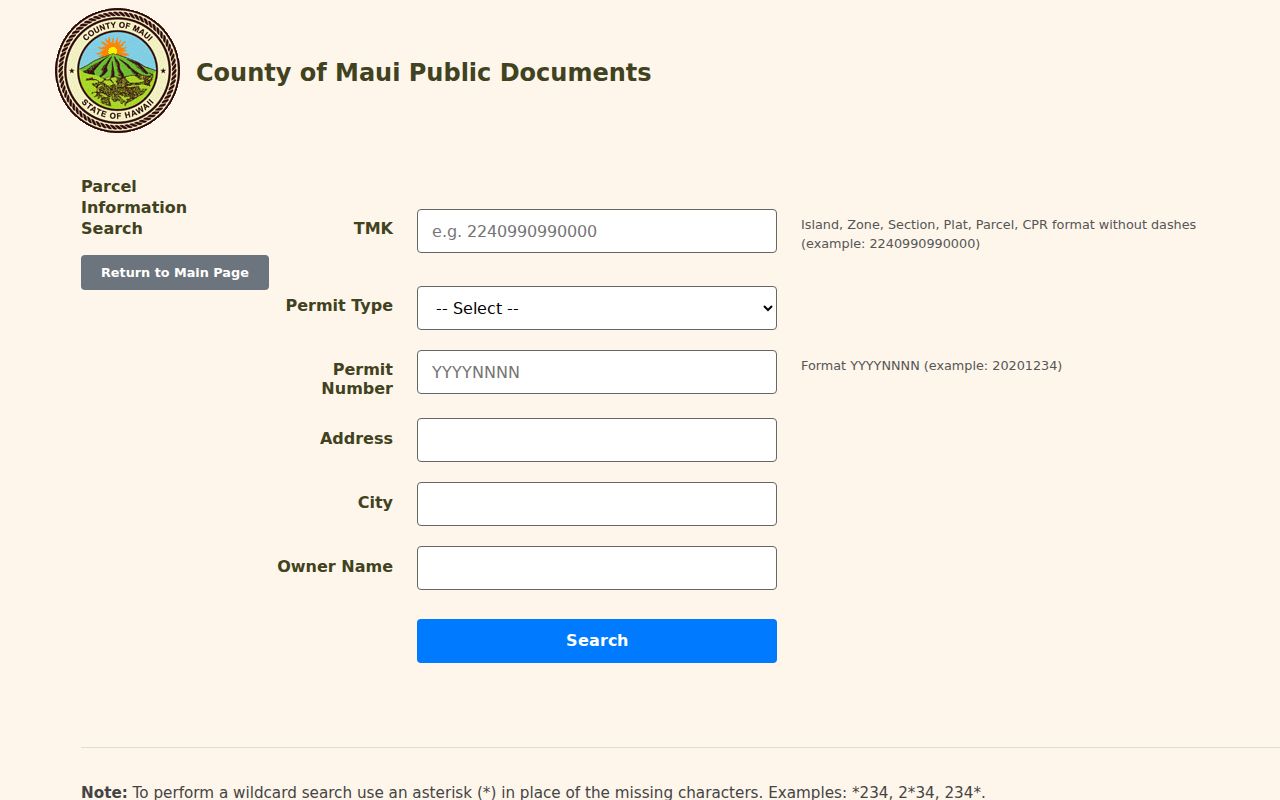
This screen matters because it exposes the county keys used to move from an address into permits, parcel history, and map folders without guessing at a resident name.
Kihei Records Indexed by Street
No single Kihei street directory contains every address relationship. The useful record sets are held by Maui County, statewide offices, USPS, and historical repositories. This coverage table separates what each keeper can show from how it can be reached.
| Record Set | Keeper | What It Shows | Access |
|---|---|---|---|
| Assessment roll | Maui RPA | Owner, owner type, mailing fields, parcel key | qPublic, office, phone, data files |
| Parcel GIS | Hawaii GIS and Maui Planning | Parcel shape, TMK, assessment and zoning context | REST layer, county map hub, Planning help |
| Recorded instruments | Hawaii Bureau of Conveyances | Grantor, grantee, type, date, number, book/page | Account search, Honolulu room, written request |
| Election data | Maui County Clerk Elections | Regulated voter fields for a certified purpose | Application and affidavit, not casual lookup |
| Permits and plans | Maui MAPPS and public documents | Permit, plan, inspection, code case, old map files | Public search, account services, office, UIPA |
| Historical directories | HSA, HSPLS, LOC, UH | Dated telephone, business, or locality entry | Scans, catalog, library, archivist |
The TMK is the strongest connector. It links the assessment and GIS records, works in county document searches, and can narrow a Bureau of Conveyances query. A street name is less stable. Postal spelling, county situs wording, unit style, and older locality terms may differ.
Kihei Address Labels Differ
USPS, RPA, and recorded documents may describe one property in different ways. USPS provides a delivery label. The situs address is the physical or tax location used for the parcel. RPA's mailing address is where owner correspondence goes, which may be off island or tied to an entity. Preserve all three with a source date.
- Parcel
- A mapped unit of land identified by a TMK.
- Situs address
- The county's location label for the parcel, distinct from an owner's mail destination.
- Plat
- A recorded or administrative map showing lots, lines, or subdivisions.
- Criss-cross directory
- A directory arranged by address or phone rather than only by surname.
Owner type also matters. A fee-simple owner, lessee, trust, company, or estate representative has a property relationship, but the label does not establish present occupancy. This is a central limit of any address-based directory.
Map Kihei Streets by TMK
The state Maui parcel layer exposes geometry and parcel attributes, including section, plat, parcel, TMK text, tax acres, GIS acres, value fields, zoning, and a qPublic link. Query a known TMK first. Then inspect nearby shapes while recording the layer date. Geometry shows map context, not a legal survey or a list of people.
The official parcel query is a useful technical fallback when a visual portal is slow or blocked.
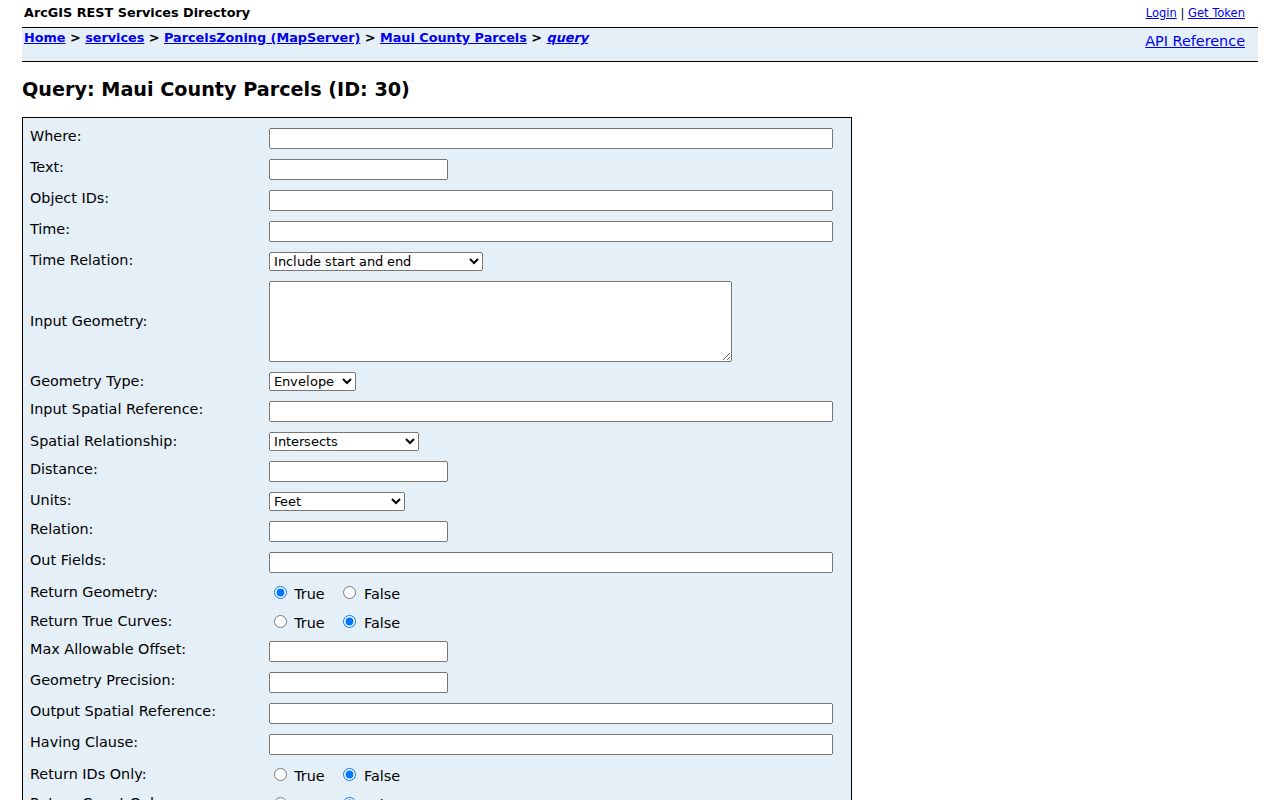
The query view makes the street directory reproducible because a researcher can save the TMK, selected fields, geometry choice, and date instead of relying on an unlabeled map screenshot.
Kihei Street Permits and Plans
MAPPS searches address, TMK, case number, and general terms. Its public categories include permits, plans, inspections, code cases, and business licenses. Public result cards show a record number and category. An account is not required for public search, though applications, requests, and payments use an account.
When MAPPS has no hit, try the county public-documents index. It reaches historical categories such as subdivision files, civil as-builts, planning maps, master plans, field or parcel books, ownership-history books, and map-history folders. Search the exact address, a road-suffix variant, the TMK without dashes, then a wildcard and category. The May 2026 MAPPS migration notice is another reason to date the portal link and keep the county support route.
Kihei Deeds Along a Street
The Bureau of Conveyances is Hawaii's statewide recorder. Its online index reaches documents from January 1, 1976, and requires an account. Search is free, while clear document images require purchase. Older material can be researched through the Honolulu public room or a written request that includes names, date range, island, location, property address, and TMK.
Search names as grantor and grantee. A grantor transfers an interest; a grantee receives one. Exact, SoundEx, and alias choices help with spelling. Then narrow by TMK, recording date, document number, book and page, or certificate number. Document formats changed over time, from liber/page to year-number and later digit strings, so record dates guide the search.
A deed hit must be labeled by instrument type. Mortgages, releases, easements, declarations, trusts, and probate transfers can name people who never occupied the street address. For pre-1976 work, call BOC at 808-587-0147 or use its written-search route before assuming the online street directory is complete.
The online account is only one access channel. The BOC public research room is in Room 123 of the Kalanimoku Building in Honolulu, and the written form supports mail delivery. Its published instructions use different fee-era splits for older searches, so give the office the exact recording range and ask which current charge applies. Bring the TMK, island, approximate date, names, and property address. That detail lets staff distinguish a specific instrument search from a request to build a new ownership list.
Kihei Street Voter Limits
Hawaii does not offer an unrestricted name-to-residence voter portal. HRS §11-97 distinguishes public fields from the rest of the voter affidavit, and Maui County uses an application with an affidavit, stated purpose, format choice, and fee. The online voter service is meant for a person to register or update their own record.
For authorized data, contact Maui County Clerk Elections at 808-270-7749 and use the current application. Phone, mail, fax, and in-person routes remain available. A library may help locate the form, but it cannot release protected fields. Never use a voter file to infer every adult at an address or to bypass Hawaii's Address Confidentiality Program.
Older Kihei Street Records
Past address labels require a wider search. Hawaii State Archives, the Maui Historical Society, the Library of Congress Wailuku telephone scan, and the UH island-directory bibliography preserve dated leads. Search both Kihei and Kīhei. The official geographic-name form uses the macron, while older catalogs and OCR often do not.
RPA field and ownership-history books extend county parcel context through 1987. The UH bibliography identifies Polk's directories of Hawaii, Maui, and Kauai, including Lanai and Molokai, from 1954 through 1987. Exact reverse-address holdings at Kihei Public Library were not published, so ask the branch for the target year and medium. The Kihei city directories page owns the full historical shelf.
When the street name itself is unclear, search HSA Digital Archives by surname, locality, district, and date, using wildcard and spelling variants. Maui Historical Society finding aids add maps, plats, land ledgers, and family collections through an appointment route. Kihei Public Library can check the HSPLS catalog, genealogy databases, and Ask a Librarian channel. State Archives is in Honolulu, while the library and county offices provide Maui-based help. Record a catalog or finding-aid hit as a lead until the underlying page is checked.
Limits of Kihei Street Records
A street directory built from public records cannot prove who is inside a home now. The assessment roll identifies a property relationship. BOC identifies recorded parties. A permit identifies a project or applicant. A historical directory supplies a dated association. Protected court, vital, voter, and substitute-address data remain governed by their own rules.
Keep a short record note for every result: query, source, access date, record date, TMK or document number, field meaning, and what remains unknown. If an online portal fails, use the RPA or Planning counter, BOC research room or written request, library reference desk, archives, or a narrow UIPA request for an existing county record.
Lawful use. Use Kihei address records only for lawful personal research. Never use them to stalk, harass, intimidate, or uncover a protected address.