
Finding Residents in Kihei
Kihei is a census-designated place, not an incorporated city. It has no separate city clerk, city hall, police department, court, or municipal resident register. The useful records are divided among Maui County, statewide Hawaii agencies, the Judiciary, and historical repositories. That division makes the first question important: are you trying to identify a parcel owner, a party named in a deed, a court participant, a registered voter process, or a person in an older directory?
The Kihei residents directory works best as a source map, not as a claim that every person can be found. Owners may live elsewhere, many occupants never appear in parcel records, voter information is purpose-limited, and vital records require statutory eligibility. Use the relationship stated by the record and preserve its date.
- Normalize a known address with USPS, then obtain its Maui tax map key.
- Search the county parcel tools for ownership and assessment context.
- Use the Bureau of Conveyances index for recorded property interests.
- Check eCourt Kokua or another official name index when the record type calls for it.
- Ask a library or archive for directories and material outside online coverage.
Kihei Records Follow County Lines
Maui County is the local government layer for Kihei. The Office of the County Clerk is mainly a routing authority for this work: its Elections Division handles voter administration, while birth, death, marriage, land, and court questions go to their respective state custodians. The county's staff directory likewise helps locate Planning, Public Works, Police Records, Elections, and Real Property Assessment, but it is not a roster of residents.
This local structure prevents a common dead end. A request sent to a nonexistent Kihei clerk cannot reach the record. Identify the custodian first, then use the office's portal, counter, mail form, telephone contact, or public-records request channel. The County Clerk works from 200 South High Street, Room 708, in Wailuku and publishes separate election and legislative telephone lines.
Local distinction: “Kihei,” “Kihei CDP,” postal Kihei, and the Kihei-Makena planning area describe different boundaries.
Kihei Resident Record Custodians
Three offices answer many of the first questions behind a Kihei residents directory. Maui Real Property Assessment identifies parcels and reported owners. The statewide Bureau of Conveyances indexes recorded instruments. The County Clerk's Elections Division administers voter processes and regulated voter-data requests. None is a general household list, and each uses a different meaning for a person's connection to an address.
The Maui County Clerk page is the official local routing point for election administration and referrals to the agencies holding land, court, and vital records.
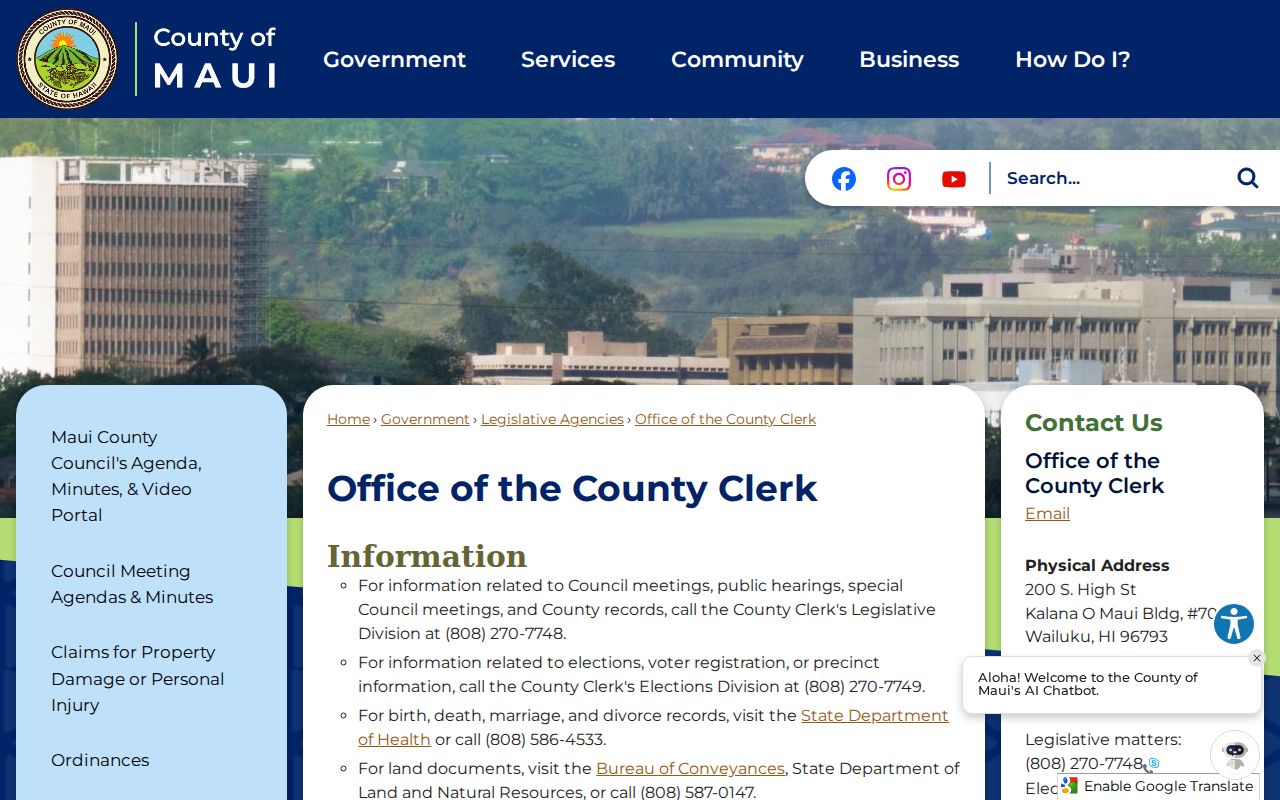
The page confirms why a Kihei inquiry may begin locally in Wailuku even when the requested record ultimately belongs to a Hawaii state custodian.
Maui Real Property Assessment
110 ‘Ala'ihi Street, Suite 110
Kahului, HI 96732
808-270-7226
Maui County Elections
200 South High Street, Room 708
Wailuku, HI 96793
808-270-7749
From Kihei Address to TMK
An address search should begin by preserving the exact address as supplied, then checking its standardized postal form. The county parcel search can use a location address, owner name, tax map key, map, or sales criteria. Maui's TMK identifies island, zone, section, plat, parcel, and condominium property regime where applicable. Once found, that key connects the county property roll, public documents, planning material, and the state parcel layer.
Read the owner, mailing, and situs fields separately. County ownership metadata includes owner type and mailing-address lines, which can point away from Kihei or name an entity, trustee, or lessee. Those fields do not establish occupancy. The detailed address workflow, wildcard behavior, and parcel-to-deed sequence belong in the Kihei street directory.
Kihei Deeds Need Two Searches
The Bureau of Conveyances online service supplies Hawaii's statewide recorded-document index. Search results can carry document number, recordation date, document class, grantor and grantee, person or entity designation, TMK, certificate or book and page, and related-document links. The index relationship is precise: it shows that a named party appears on an instrument, not that the party resides on the parcel.
The free index and document images are separate. Older material or an uncertain search may require the Bureau's research room or written search form. The form asks for names, approximate date, island, location, property address, TMK, and document class. Online coverage begins January 1, 1976, while pre-1976 research is routed through staff and physical records.
The image below shows the official online-services entry point. Its account, search, and image-purchase choices explain why a name can be indexed even when the underlying document is not freely visible.
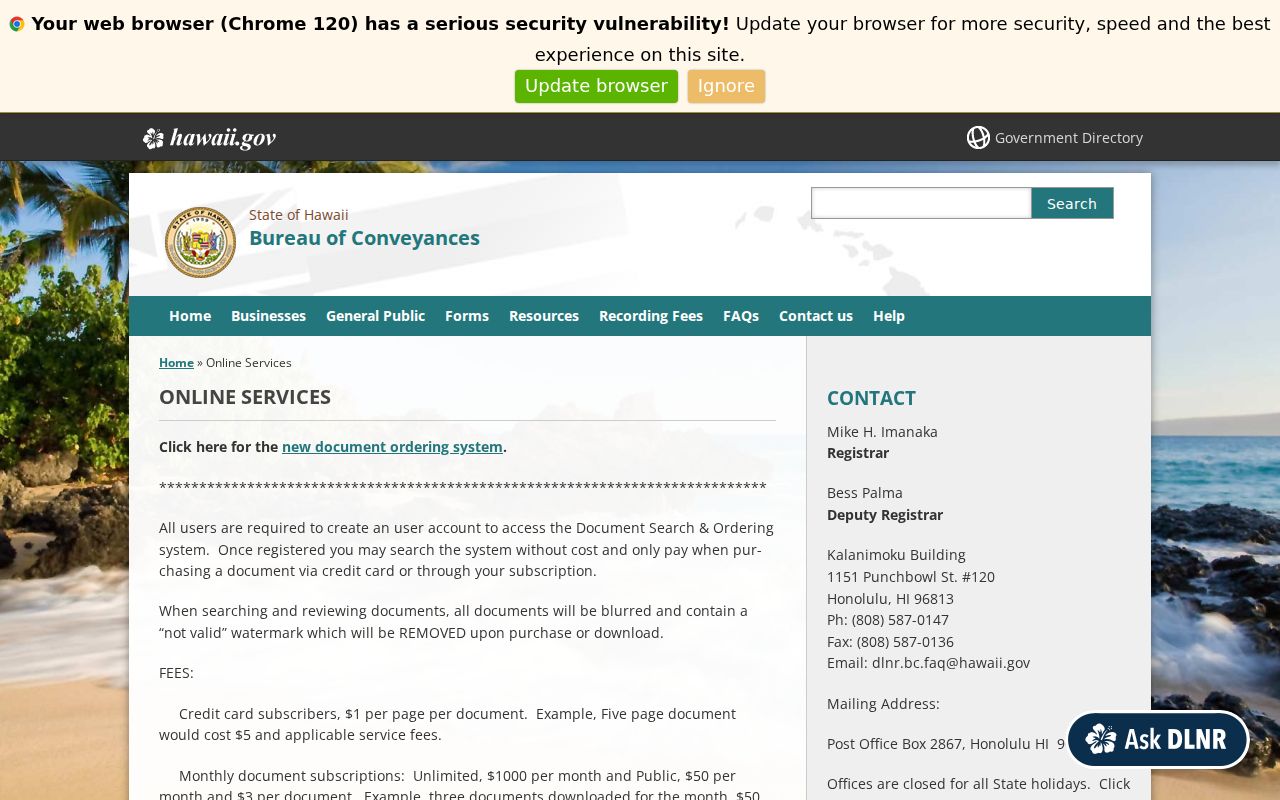
Record the document number and date before leaving the results screen, then use those stable identifiers when requesting a copy.
Current Kihei Directory Sources
No current source covers all Kihei residents. Instead, official systems publish limited relationships for a defined public purpose. Match the source to the question and do not convert a narrow field into a broader identity claim.
| Official source | Relationship shown | Custodian | Access route |
|---|---|---|---|
| Real property roll | Reported owner and parcel | Maui RPA | qPublic, office, data extracts |
| Recorded document index | Party to an instrument | Bureau of Conveyances | Online index, written search, research room |
| eCourt Kokua | Party in a public case | Hawaii Judiciary | Online search, Second Circuit counter or request |
| Voter process | Registration or regulated data | County Elections | OLVR, paper form, data affidavit |
| County resource directory | Organization listing | Maui County | Category, organization, city, state search |
For one named person, keep a result table with source, role, event date, access date, and identifier. The Kihei resident lookup explains how to compare names without merging unrelated people.
Verifying a Kihei Name Hit
A name match is a starting point. Hawaii eCourt Kokua warns users that a name alone does not confirm identity. Its public case results include Case ID, type, status, filing date, court, location, and party roles. Use the Case ID and filing details to distinguish people with similar names, and do not describe a court party as a Kihei resident unless a separate source establishes that relationship.
The same discipline applies elsewhere. A professional license confirms a credential and status; unclaimed property identifies a possible owner; a recorded instrument names a party; a historical directory supplies a dated listing. Preserve aliases, middle names, dates, and source spelling. If the record has no stable identifier or the date falls outside online coverage, contact the custodian rather than forcing a conclusion.
Kihei Voter Data Has Limits
Hawaii's online voter registration portal is for registering or updating one's own information, not unrestricted name-to-address browsing. Maui County accepts voter-data applications through its Elections Division, but the applicant must identify the purpose and certify restrictions on sale, release, distribution, and commercial use. HRS §11-97 separates public election information from confidential affidavit data.
The county application describes options to purchase data, review a roster, or request another format, together with delivery choices and applicant contact fields. A dated form lists a fee, so confirm the current amount before paying. For ordinary personal verification, the safest route is to ask the person or use the official self-service channel rather than seeking protected voter details.
Kihei Vital Records Stay Restricted
The Hawaii Department of Health keeps birth, death, marriage, and civil-union records under HRS §338-18. Access depends on a qualifying relationship or tangible interest, and order forms require identity and event details. Divorce routing changed in 2026: more recent divorce documents are handled through the Judiciary, while the Department of Health retains older divorce-record responsibilities described in its current guidance.
Genealogy access is different from current certificate ordering. DOH says records more than 115 years old are available for genealogy research, with forms and lineage evidence for younger restricted material. Researchers can use appointment, mail, and microfilm routes where applicable. The official vital-records page should be checked before choosing a form.
The captured landing page below helps confirm the current custodian and service split. It should not be read as evidence that a named certificate is public.
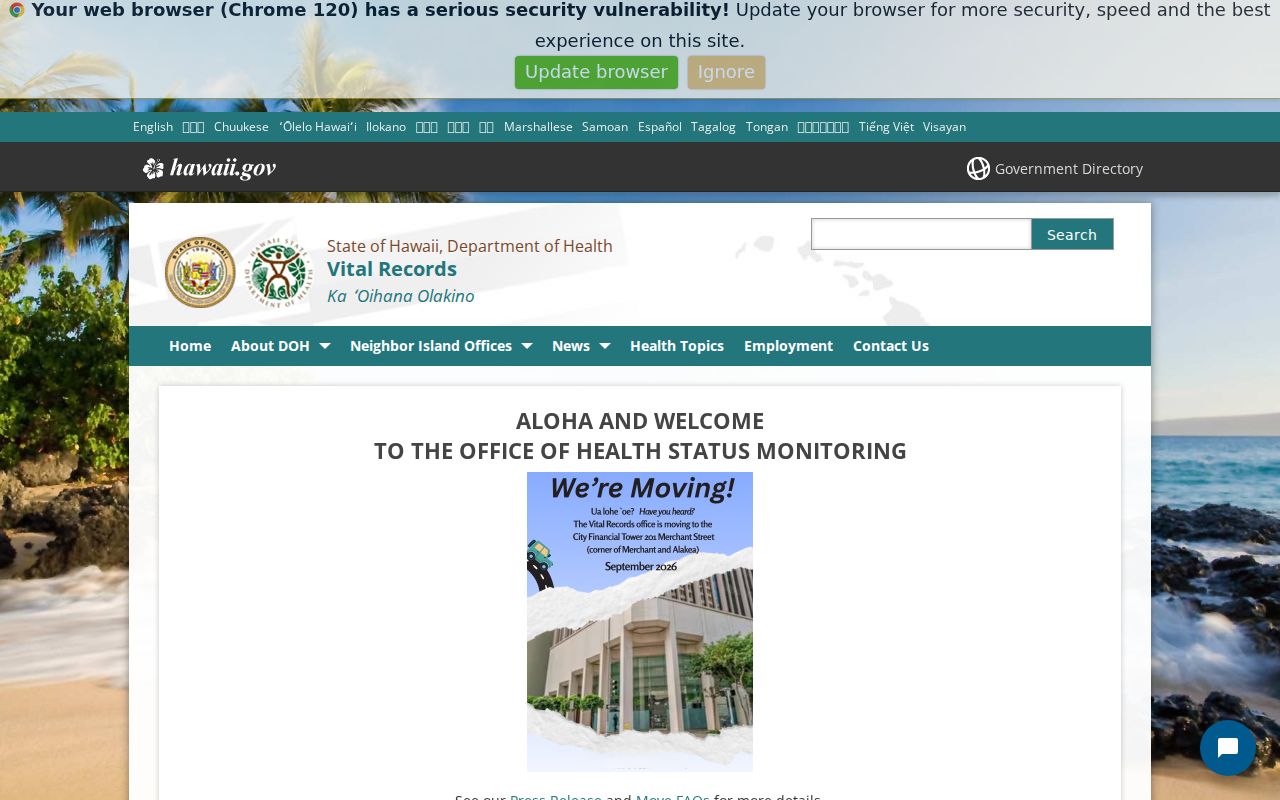
Use the event type and eligibility rule to select the correct request route before submitting personal information.
Requesting Unlisted Kihei Records
Hawaii's Uniform Information Practices Act, HRS chapter 92F, provides a process for requesting government records from the agency that maintains them. A written request needs a reasonable description, requester contact information, and the preferred inspection or copy method. The requester does not have to explain why the record is wanted. The agency may still withhold protected information, and UIPA does not require it to create a new compilation that it does not maintain.
Send the request to the custodian, not the Office of Information Practices. Maui's online portal serves participating departments, while mail, in-person, and other written channels remain available. If an agency does not respond or gives an incomplete response after 10 business days, OIP guidance explains how to seek assistance. Ask for an estimate when research, review, or copying fees may apply.
The state request guide shown below separates agency requests from OIP appeals and assistance.
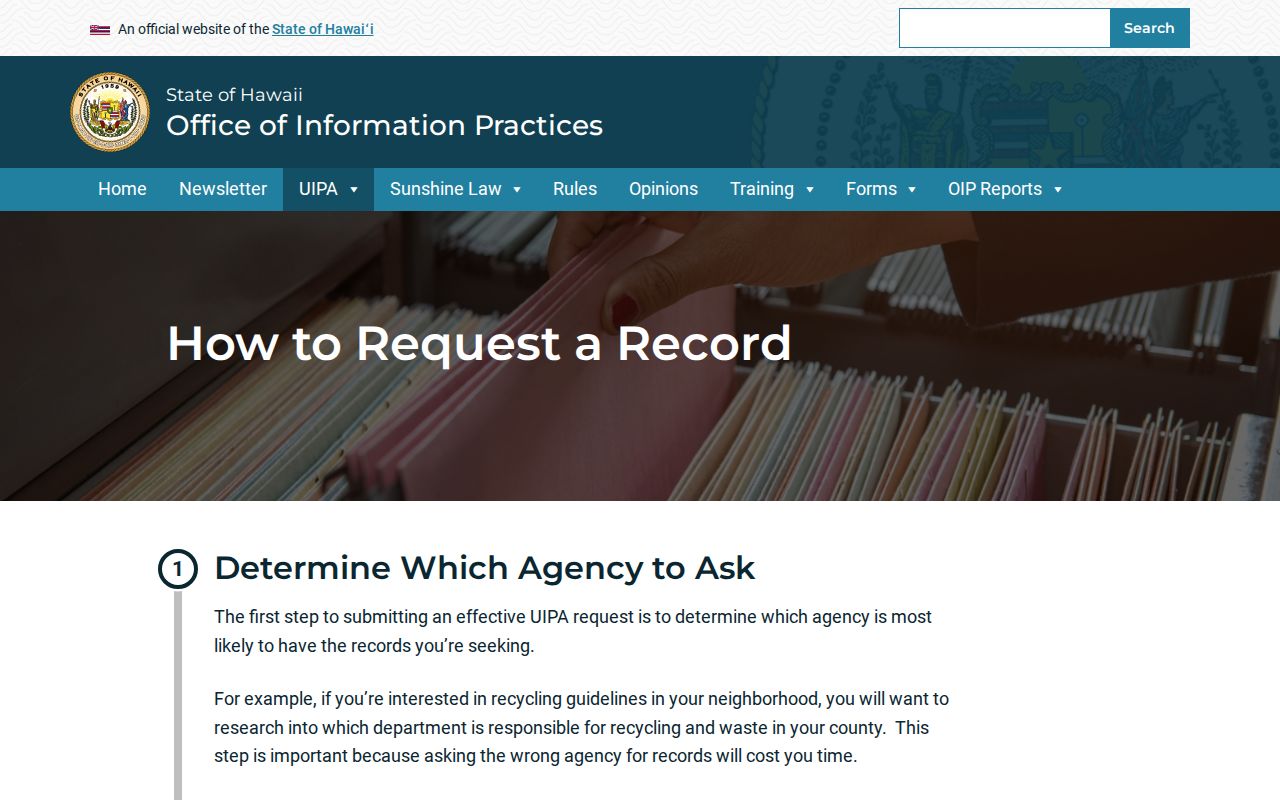
Keep a copy of the request, its submission date, the agency response, and any estimate or tracking number.
When Kihei Portals Fail
A blank result may mean the wrong agency, an alternate spelling, a date outside web coverage, a protected record, or a portal gate. It does not necessarily mean no record exists. qPublic may be searched by owner, location, TMK, map, or sales criteria, but the live endpoint was blocked during unattended research. MAPPS also changed its self-service route during a 2026 modernization.
Use the documented fallback for the record type: RPA staff and county data extracts for parcels; the Bureau research room or written form for deeds; the Second Circuit counter or mailed record request for court material; DOH order forms for eligible vital records; and librarians or archivists for unindexed history. Date-stamp every web link because transitions can change the correct entry point.
Search Kihei and Kīhei
The Hawaii Board on Geographic Names uses the spelling Kīhei, while government portals, older publications, and optical character recognition commonly use Kihei. Search both forms before treating an archive result as absent. Historical material may also be filed under a district, island, publisher's coverage city, or older locality term rather than today's census place.
This small variation matters in the Kihei residents directory. The 1963 Wailuku telephone directory scan contains lines using Kihei as a locality, even though the volume is not titled as a standalone Kihei city directory. Preserve the spelling printed in each source and record the edition and page. A spelling variant improves retrieval; it does not broaden the source's geographic meaning.
Kihei Boundaries Change Results
ZIP 96753, the Kihei CDP, Kihei census county subdivision, the Kihei-Makena Community Plan area, and the Kihei Community Association's South Maui service area are related but not interchangeable. A postal result speaks to mail delivery. A Census figure describes its published statistical boundary. A planning map organizes land-use policy. KCA describes a civic area from Maalaea to La Perouse and does not publish a membership roster.
Write the geography next to every result. If a parcel appears near a boundary, use its TMK and source map rather than assuming the postal city controls. The Kihei ZIP code directory compares these layers without turning ZIP geography into a people index.
Historical Kihei Directory Trails
Historical research has several shelves. Hawaii State Archives identifies Polk and Husted city directories and has digitized selected volumes. The University of Hawaii bibliography lists island directories extending through 1987. The Library of Congress offers digitized Wailuku and Hawaii White and Yellow Pages from 1958 through 1963, including a dated Kihei locality clue. Maui Historical Society finding aids add family, land, church, map, plat, and organization collections.
Kihei Public Library can help locate genealogy databases and catalog material, while the State Archives genealogy guide points toward census, probate, vital statistics, and directories. In January 2026, DAGS reported digitization of 64 archive index volumes spanning the early 1800s through the late 1990s. Some underlying records still require an archivist, so an online index should be recorded as a lead rather than a complete file.
The full Kihei city directory collections guide explains publishers, years, search variants, and how to read a historical entry without presenting it as current residence.
Keep Kihei Research Reproducible
For each result, note the exact query, source title, URL, access date, record or event date, identifier, relationship shown, and remaining uncertainty. Two dates are especially useful for systems with weekly or nightly refreshes and for portals undergoing migration. A screenshot alone can lose the search terms and field definitions needed to repeat the work.
Use neutral labels such as parcel owner, recorded party, court party, historical directory entry, organization, or map context. Do not collapse those categories into “resident.” Compare independent sources only for a lawful personal purpose, and stop when a confidentiality rule or substitute address protects the person. Hawaii's Address Confidentiality Program is designed to shield qualifying survivors and should never be defeated by combining public fragments.